RESEARCH 01 // studies in people and mice
Thymosin alpha-1 research shows possible help, with important limits
You’ll see who was studied, what changed and how sure the finding is.
Immune message spots 9 and 2 both changed lab cells
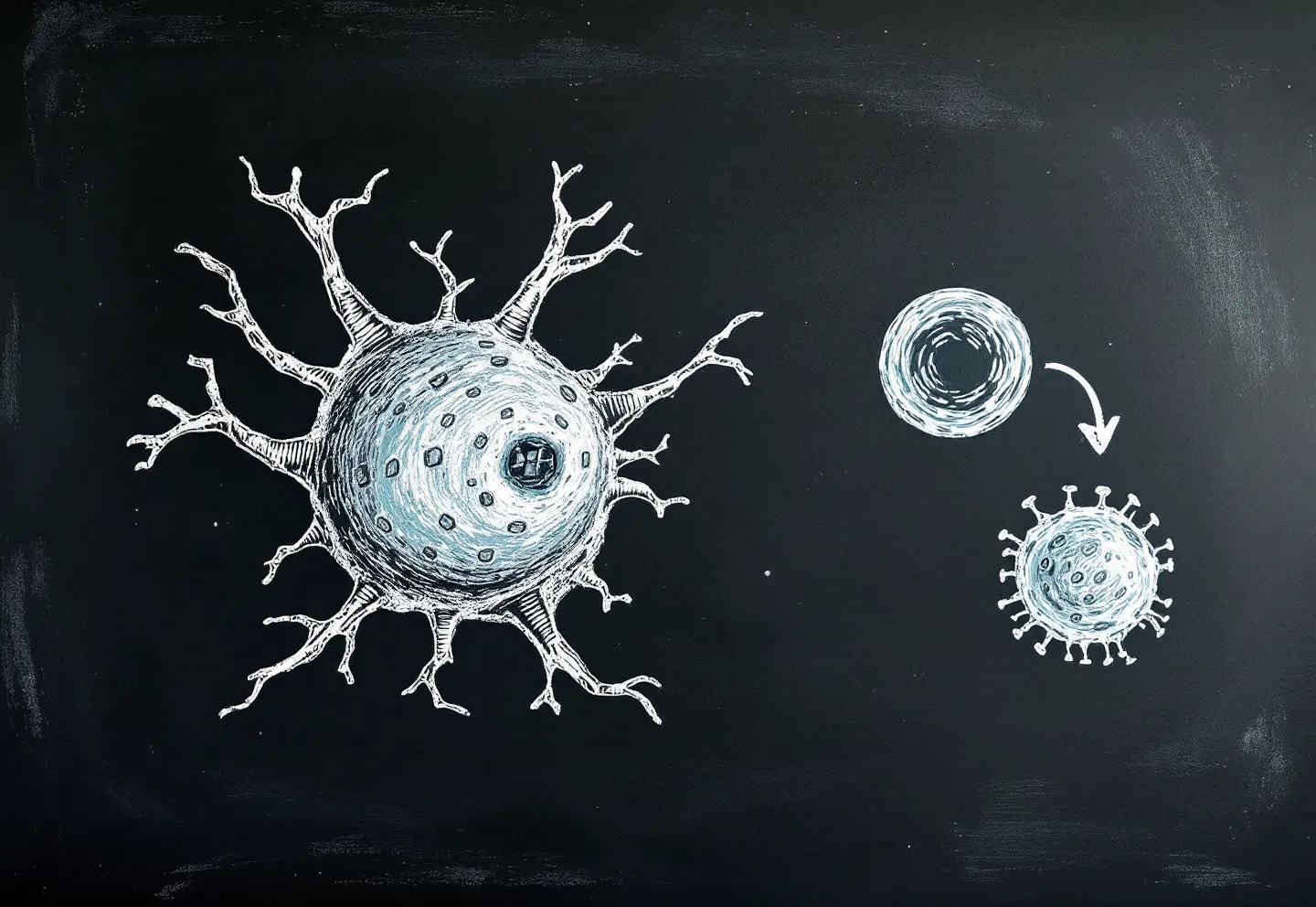
Two papers help explain how Thymosin alpha-1 may work. In 2006, Romani found that Thymosin alpha-1 changed immune guide cells in dishes [4]. Some changes raised the body’s defense.
The papers number two cell message spots 9 and 2. Those numbers are only lab labels. Other changes helped calm a response that could grow too strong.
No patient received Thymosin alpha-1 in that test. Bozza’s 2007 study found a stronger virus defense in mice [5]. Thymosin alpha-1 helped guide cells alert other immune cells.
Mice aren’t people, so the finding is only an early lead. Garaci’s 2007 review follows the drug’s later move into clinics [3]. The lab work can’t show how you would feel, how your body would react, or whether you would benefit.
Thymalfasin is the man-made form sold as Zadaxin
<a id="thymalfasin"></a><a id="zadaxin"></a>Thymalfasin is the common name for the man-made drug. It has the same twenty-eight linked protein parts as the natural form found in 1977 [1]. SciClone Pharmaceuticals sells it as Zadaxin. The brand appears in 30+ countries, chiefly for hepatitis B and C [20].
A 2001 drug review describes the studies behind Zadaxin. Those studies used 1.6 mg in two skin shots each week. The drug had a roughly 2-hour stay in the blood, yet its effects lasted longer [20].
Studies behind those approvals used skin shots. You won’t find pill care in them. Staff mixed the dry drug with liquid and used it soon, as the label states [20]. For you, the key is that these were shots, your body wasn’t studied, and you didn’t take part.
Liver studies found better virus control for some patients
<a id="hepatitis"></a>Studies of hepatitis B led to approval in some countries. In 2008, Yang joined studies where chance chose each care group. The studies tested Thymosin alpha-1.
Adding Thymosin alpha-1 to interferon, a hepatitis treatment, helped more people control the virus [12]. A 2009 review tested Thymosin alpha-1 with lamivudine, another hepatitis drug. The pair controlled the virus more often and caused fewer flare-ups [13].
Sherman’s 1998 hepatitis C study compared Thymosin alpha-1 with a sugar pill. Everyone also got interferon. The Thymosin alpha-1 group got 1.6 mg through two skin shots each week [14].
More people had a better liver blood test when care ended. More also kept the virus controlled later. That later gap could still have come from chance. You can compare this finding with your care, but it can’t predict your lasting result.
Sepsis studies found fewer deaths, but proof was limited
A China study in 2013 found fewer deaths among people with severe sepsis [6]. Chance placed each person into a care group. Patients and staff didn’t know who got Thymosin alpha-1.
Patients got 1.6 mg in a skin shot twice daily for 5 days. They then got Thymosin alpha-1 once daily for 2 days. Fewer people died by twenty-eight days. A blood test found more immune cells ready to fight infection.
Li’s 2015 review joined several sepsis studies [7]. It again found fewer deaths with Thymosin alpha-1. Some studies gave different care or watched people for different times.
No single study gave a firm answer by itself. Think of several weak ropes tied together. Joining them adds strength, but the knots still matter. You still need someone who knows your health before you weigh your own care.
COVID-19 studies found fewer deaths, but chance wasn’t tested
Four studies lead the COVID-19 work. Liu’s 2020 Wuhan COVID-19 study followed 76 very sick patients. Deaths fell from 30.0% to 11.1% by twenty-eight days.
Patients got 1.6 mg of Thymosin alpha-1 in a skin shot once daily [8]. The paper labels two blood signs with the numbers 1 and 3. Those signs showed how worn out the immune cells were.
Sun’s 2021 COVID-19 study linked earlier Thymosin alpha-1 use with fewer deaths by 28-day [9]. Matteucci’s 2021 lab study used blood from COVID-19 patients. Thymosin alpha-1 calmed a harmful flood of immune chemicals in those samples [10].
In 2023, Matteucci studied Thymosin alpha-1 in people with long COVID-19. That illness follows the virus called sars-cov-2, which causes COVID-19. Immune-cell counts moved closer to normal than in untreated people [11].
Wan’s 2023 COVID-19 review joined studies of very sick patients [22]. It found fewer deaths overall. Another 2023 COVID-19 review reached the same broad result [23].
Most studies looked back after care choices were already made. They didn’t use chance to form the groups. Other care could have caused part of the difference. You can see the limit: other care may have shaped the result, so your outcome could differ for you.
Cancer work points to immune support, not a cure
<a id="oncology"></a>Thymosin alpha-1 hasn’t been shown to kill a tumor by itself. Liang’s 2020 work studied lung cancer in mice and human samples. Thymosin alpha-1 blocked cells that hold back the body’s tumor defense [15].
Other immune cells then fought the cancer more strongly. That’s a lab finding. It can’t tell you how long a person might live.
Moody’s 2007 paper reviewed lung and breast cancer work [17]. Costantini’s 2023 review covered newer care that helps immune cells attack cancer [16]. Most patient studies came from one center in China.
The best results came when usual cancer care included the drug. Some studies gave it after surgery. Few large studies across several nations tracked how long people lived. You can’t carry the mouse result over to your tumor or your treatment.

Older men made more flu antibodies after treatment
Two older studies looked at people with weak immune systems. A 1989 study enrolled older men. Each man received a flu shot with Thymosin alpha-1.
They received 900 micrograms through two skin shots each week for 4 weeks. A microgram is one-thousandth of a milligram. The Thymosin alpha-1 group made more flu-fighting antibodies than the sugar-pill group [18].
A 2010 study followed people after a partly matched stem-cell transplant. They got 1.6 mg through two skin shots each week [19]. Two viruses called CMV and EBV returned less often.
Those viruses can stay quiet after an earlier infection. Infection-fighting cells also came back sooner. Both Thymosin alpha-1 studies suggest help for worn-down defenses, but healthy immune systems weren’t tested [4][5]. Neither study tells you how your healthy immune system would respond for you.
Thymosin Alpha-1 usually caused brief shot-site pain
<a id="side-effects"></a>Thousands of people took Zadaxin in the published studies [20]. Doses ran from 0.8 mg to 16 mg in skin shots. Brief pain and mild redness at the shot spot were most common.
Even at 16 mg, no problem made researchers set a lower dose limit. That doesn’t prove the amount is safe for everyone. The reports also didn’t name one blood-test problem that kept appearing.
These studies show what happened to many people, not what will happen in your body. Studies left out people with active autoimmune disease. With that illness, your defenses can harm your own tissue.
People taking drugs that quiet the immune system after an organ transplant were also left out. The drug might work against those medicines. Pregnant or nursing people weren’t studied either. Your health can change your risk, even when you don’t see a common problem.
Studies most often reported pain and redness
Billich’s 2001 drug review found few common problems. Pain and brief redness at the shot spot led the list. Up to 16 mg, no problem made researchers set a lower dose limit [20].
That finding doesn’t prove the amount is safe for everyone. The reports didn’t name one blood-test problem that kept appearing. A rare problem could still affect you, your health, or the medicines you take.